Inlays or fillings? It’s really not a question.
Inlays oder Füllungen
Book an appointment

If a tooth is affected by tooth decay, the decay must be removed and the hole in the tooth must be filled either with a filling or an inlay.
Depending on the size of the defect, we decide whether a filling is sufficient or whether an inlay is necessary.

Composite fillings, also known as plastic fillings, are mainly used for smaller defects. The tooth-coloured plastic material is applied by the dentist in layers directly in the patient’s mouth. A disadvantage of composite fillings is that they shrink over time, creating a gap between the filling and the tooth into which bacteria can enter, promoting the formation of new caries. For this reason, fillings usually need to be replaced after a few years. A filling has a lifespan of approximately 5–7 years.

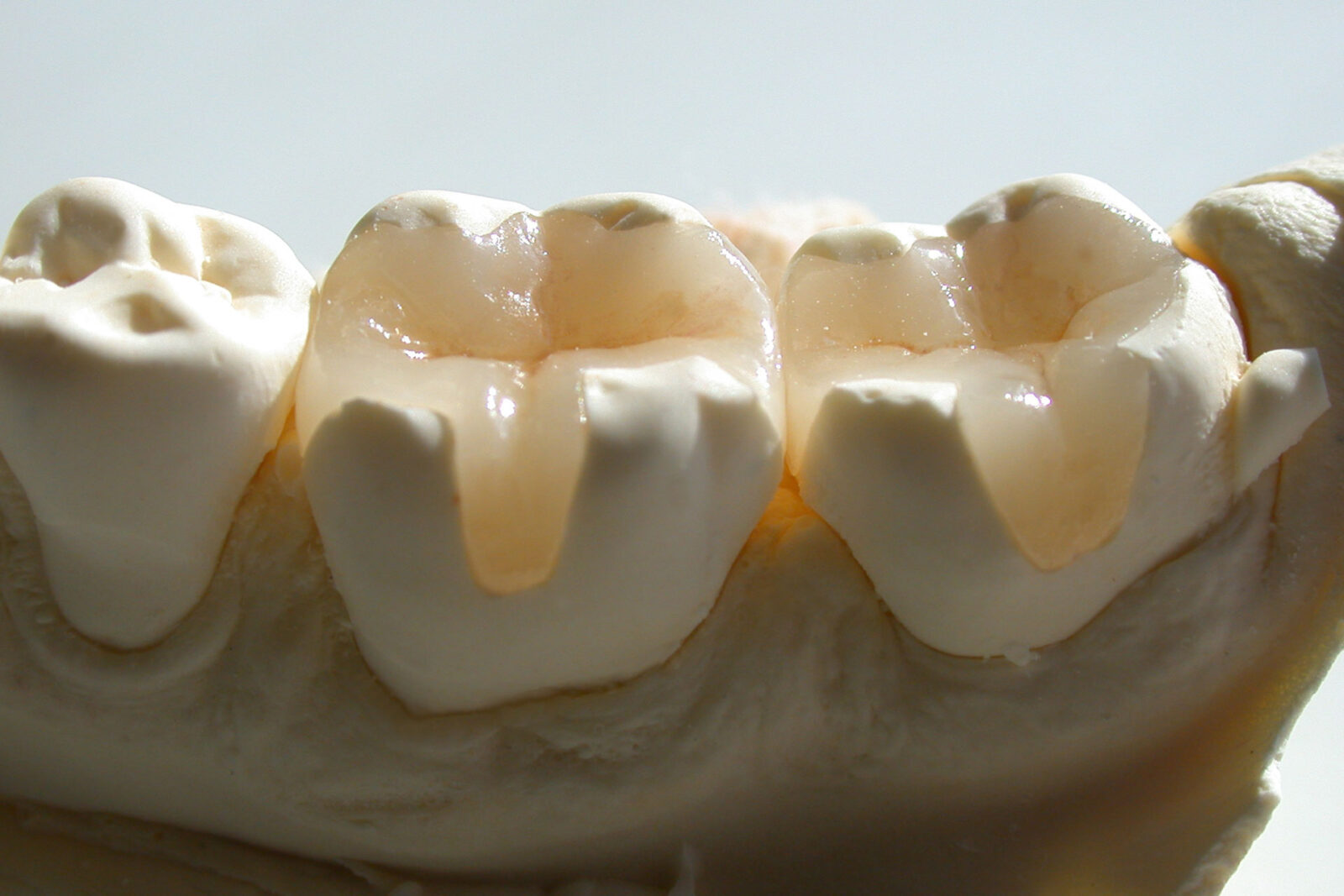
Inlays, on the other hand, are the best alternative to standard fillings. They are made either of gold or ceramic.

The advantages

  • Long-lasting. (With proper care, 15 years or more)
  • Bacteria-resistant
  • Withstands high chewing forces
  • Rarely causes
  • allergic reactions
  • Perfect aesthetics

The treatment

Once the decay has been removed, a digital (photographic) impression is taken at our practice. The dental technician receives this data and crafts the perfect dental restoration for you.

The finished inlay is fixed into your tooth in one piece, which has the advantage of being dimensionally stable and not gradually shrinking. This prevents bacteria from penetrating and helps prevent further tooth decay.

Inlays last much longer than fillings and do not need to be replaced after a short time.

All-ceramic inlays impress with their excellent aesthetics.
They are almost indistinguishable from natural teeth, can be fitted precisely and last a very long time.
Ceramic is also characterised by its colour stability and high biocompatibility.

The bond between the ceramic inlay and the tooth is created using an adhesive. In contrast, gold inlays are cemented in place.
They are the most robust solution for inlays in the posterior region, as they can withstand heavy chewing forces yet remain soft and do not damage the opposing tooth.

Gold is also biocompatible and has a very long lifespan.

And – also worth mentioning: gold inlays are highly recommended for patients who grind their teeth.

Dr Kleopatra Ziata-Otto's Dental Practice

  • Dental care for adults
  • Dental care for children
  • Cosmetic dentistry
Book an appointment
implant24.com
zirkon